Can AI Redefine Authenticity? Van Eyck’s Masterpieces Put to the Test

When artificial intelligence enters the world of fine art, it doesn’t just ask questions—it rewrites them. This is exactly what’s happening now, as new AI art authenticity analysis challenges the attribution of two major works long believed to be by Jan van Eyck, the legendary Flemish painter whose influence shaped centuries of European art. For museums, collectors, and historians, the implications are massive.
Max Global brings you the full story behind the digital investigation that’s shaking the foundations of Jan van Eyck authenticity in both Europe and the United States.
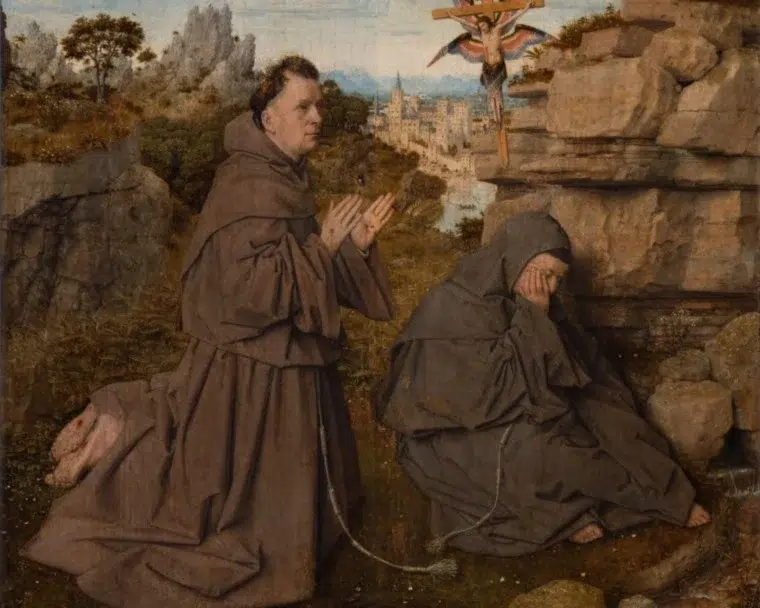
Art Recognition AI triggers scientific disruption
According to The Guardian, two paintings titled Saint Francis Receiving the Stigmata—one held at the Philadelphia Museum of Art and another at the Sabauda Gallery in Turin, Italy—were recently examined by Art Recognition, a Swiss-based company specializing in artificial intelligence authentication. The research was conducted in partnership with Tilburg University in the Netherlands.
The system analyzed the digital features of both works, comparing thousands of micro-patterns in the brushstrokes to known verified Van Eyck paintings. The results were startling: the Philadelphia version scored 91% negative for authenticity, while the Turin version scored 86% negative, meaning that the algorithm found no match to Van Eyck’s typical brush signature.
A challenge to Jan van Eyck authenticity
The results support theories that these works may have been executed by the artist’s workshop, rather than Van Eyck himself. Till-Holger Borchert, director of the Suermondt-Ludwig Museum in Aachen, Germany, acknowledged that scholars have debated this possibility for years. “The AI results confirm that we must reconsider the scope of Van Eyck’s direct involvement,” he said.
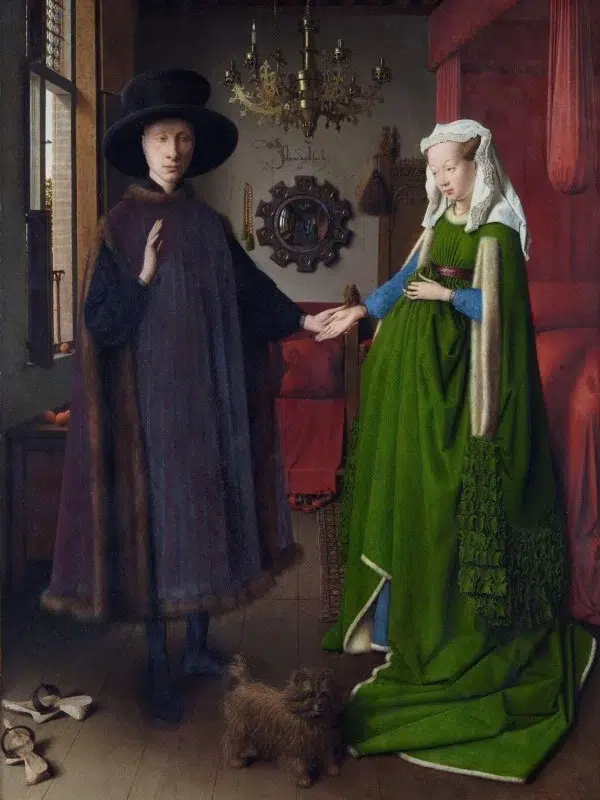
By contrast, when the same AI model analyzed the famous Arnolfini Portrait at the National Gallery in London, it detected a match with 89% certainty, strongly supporting its attribution. This contrast adds weight to the concerns raised by the new AI assessments, reigniting academic debate around AI art authenticity and the methods we use to define authorship.
The promise and limits of AI in art restoration
The growing role of AI in art restoration and authentication is reshaping how institutions handle historical artworks. Today’s machine learning models don’t just look at visual patterns—they process pigments, textures, and stroke geometry at levels beyond human capacity.
Still, conservators warn that AI models can be misled by prior restorations or physical damage. Paintings from the 15th century, like those attributed to Van Eyck, often undergo multiple conservation treatments. These interventions may distort the data, and thus alter the machine’s conclusions.
This tension lies at the heart of the Van Eyck painting analysis debate: can a machine truly know what a 600-year-old brushstroke should look like?
Art Recognition AI sparks ethical conversation
For Dr. Carina Popovici, CEO of Art Recognition AI, the findings represent more than a tech breakthrough—they expose the blind spots in traditional attribution. In her view, combining algorithmic analysis with curatorial knowledge leads to a better understanding of the truth.
But critics remain cautious. They question whether machines should be allowed to influence historical narratives. Are we risking too much by letting code dictate who painted what? Or are we simply using better tools to correct the record?
Regardless of where one stands, the role of AI art authenticity has clearly become central in museum studies and curatorial practices across the globe.
A new future for Van Eyck’s legacy
Jan van Eyck is considered a master of oil painting—not because he invented it, but because he transformed it into an art form of luminous detail and realism. Fewer than 20 works are confidently attributed to him today. If two of those are dismissed by modern AI, the ripple effect would reach deep into catalogues, exhibitions, and the market.
As digital tools evolve, so do our standards of truth. Whether confirming or rejecting, the science of AI art authenticity is giving art history something it’s rarely had: empirical friction. Not to replace human expertise—but to challenge it, sharpen it, and move it forward.


